Talk About Tech: Looking Beyond the Digital Native Myth
Technology is now woven into almost every aspect of higher education. Virtual learning environments, digital assessment, artificial intelligence and immersive technologies are no longer optional enhancements but central to how students learn. Reports such as the EDUCAUSE Horizon Report (2026) and the Open University's Innovating Pedagogy (2026) highlight how AI and Extended Reality (XR) are reshaping learning, enabling more personalised, flexible and immersive educational experiences. At the same time, Ofcom (2026) and the Government Office for Science (2026) report that the overwhelming majority of young people own or have access to a smartphone.
It would be easy to conclude that today's students arrive at university digitally prepared.
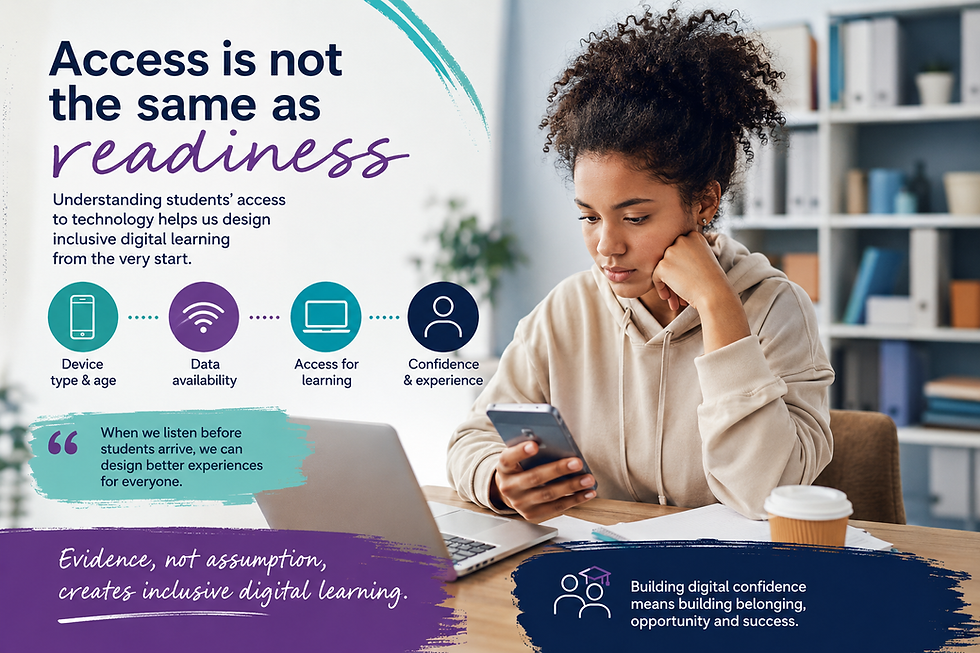
The findings from the national Pre-arrival Academic Questionnaire (PAQ), however, tell a more nuanced story. Dr Shell Morgan (Dean of Students, UEL and project lead) and I have been looking further into the data, and you can read our blog post here:
While almost all students own a smartphone, access alone does not equate to digital readiness. The PAQ data reveal important differences in the age of devices, the operating systems students use and, perhaps most significantly, the availability of mobile data. Non-UK students were considerably less likely to have unlimited data packages, while the majority of respondents were using phones that were over two years old. For around one in ten undergraduate students, their smartphone was expected to be their primary means of accessing university learning materials.
The PAQ findings also reinforce a wider message emerging from the Curriculum and Assessment Review led by Professor Becky Francis: opportunities to develop digital capabilities remain inconsistent across schools and colleges. Many students arrive having used technology extensively for communication and social interaction but with relatively little experience of using digital tools for academic study, collaborative learning or ethical engagement with generative AI. The challenge for universities is therefore not simply providing access to technology but supporting students to develop the confidence and capability to use it effectively for learning.
These findings matter because contemporary digital learning environments increasingly assume students have reliable, high-performing devices capable of supporting video-rich content, collaborative platforms, AI-powered tools and immersive learning activities. Older smartphones may struggle with software updates, battery life, storage capacity and compatibility with institutional applications. Students relying on limited data packages may avoid downloading learning resources or participating fully in online activities because of cost. The PAQ reminds us that successful transition is about more than logging on. Understanding students' prior digital experiences enables universities to design learning environments that are inclusive, equitable and responsive from the outset.
As higher education continues to embrace AI and emerging technologies, the question is no longer whether students have a smartphone. It is whether we are ensuring every learner has the opportunity, confidence and support to use technology meaningfully, ethically and successfully throughout their university journey.
Further information: The Wave One report was recently published - the report and information about taking part in this autumns Wave 2 can be accessed here: https://advance-he.org/knowledge-hub/pre-arrival-questionnaire-national-pilot-wave-one-initial-results/


Comments